The Silent Cost of Belonging
Estimated Reading Time: 12 minutes
When we begin to explore our family dynamic through the lens of constellations, the role of the mother can appear to have a greater influence on the entanglements upon us within those dynamics.
It can be easy to become entrenched in constellations involving the mother and the maternal line. This is in part because of the direct physical connection and bond between a mother and child during pregnancy, birth and the early years of a child’s life. The connection with our mother is significant for our emotional life; our ability to receive and give love is deeply influenced by her.
The mother carries more ‘weight’ in terms of the family entanglements relating to emotional connection and emotional belonging, but the father and the paternal line are influential on our physical belonging and our sense of place in the world.
Any entanglements within the relationship with our father can be destructive, because they fragment our physical belonging and sense of self.
An interruption to the connection with our father, and to the paternal line and field as a whole, is an interruption to belonging, both within our family of origin and our outer world connections. Whenever belonging is interrupted, it changes how we are seen and heard by others in our everyday life, and how we feel when we interact with others.
The interruption can be driven by many things, such as the end of your parents’ relationship in your early childhood, resulting in a loss of connection with your father or his inability to see you because of the weight of his own trauma. It can influence how safe we feel in a relationship or friendship. It is significant, but it is so often overlooked, because of the vibrancy of the emotional entanglements that come in through our maternal lineage.
The Structure of a Constellation – The point to aim for
When we begin to delve into the world of constellations and entanglements we are not doing it blindly. There is a particular order and structure that flows down from our ancestors to ourselves. This structure becomes disordered and entangled when points of trauma and events are unseen or unacknowledged in the generations before us, and the field of influence we are living through and being seen through, is not our own.
There is an optimal flow that we look to achieve within the constellation setting that is informed by the orders and structures of the field of influence upon us.
The main principles within any constellation are:
Belonging: This is where you as an individual source your belonging within your family field of influence. Commonly this is from your birth parents, but this is not always the case.
Balance: The family field itself looks to always be in a point of balance; this is how the roots of entanglements are created. If there is unacknowledged trauma within the field it will impact the field as a whole and the generations that follow will knowingly or unknowingly pick up the entanglements in an effort to balance the field. There is an unconscious familiarity with the weight of an entanglement that can be associated with safety.
Structure: The order and flow within the family, the hierarchy of belonging that runs from the ancestors to the descendants.
The flow of belonging and order can be thought of as:

The belonging for us as individuals flows to us from the structure of our family, our relationships, the community around us and the collective global influences. This belonging is based upon the balance within each part and is most often seen through a lens of shared beliefs.
Our inherited beliefs can be: cultural, religious, spiritual, political, personal or even unconscious in nature. When our beliefs, the passport to our belonging and the structural order within the field are not accepted and balanced internally within ourselves, then the field of influence will become disrupted. For example, if you have been brought up Catholic and then choose to become Buddhist. Or if your family does not ‘believe’ in divorce and you choose, reluctantly or otherwise, to become divorced. When our own beliefs are in opposition to our family or community, we can become displaced as we unconsciously try to balance that within ourselves.
In addition to our inherited and personal beliefs there is another very important factor that we need to be aware of. If there has been migration or displacement of some form within our family field of influence, then the belonging and the order within the structure of our family system is also disrupted.
Think about that for a moment – migration or displacement of any kind.
Can you think of points in your present or past family history, or indeed your partner’s family history where there has been migration? I can. I am sure you can too. This very common theme of displacement is one of the main reasons why it is important to consider our connection with our paternal line and field when beginning to work with our ancestral constellation, as any potential fracture through movement can severely impact the individual sense of belonging of future generations.
These disruptions create the entangled memories that are passed on trans-generationally and are invisibly inherited by us as individuals. It also affects how we see others and how we may perceive others as potentially dangerous for our belonging.
If we consider this cause-and-effect pattern on a global scale for a moment, then the current geo-political situation may be more understandable.
The Lands in your Blood
In my work as a therapist I have observed that there is an influence on all parts of the constellation field, from the psychohistory of different lands. However, the greatest impact is on the fathers and the paternal line and field.
Memories are held within the land and they can hold particular sway over the paternal line and the connection with the men in our life. These memories are held within us, passed silently from one generation to the next and they become stirred at points of transition, choice and change that are in resonance with our ancestors and their fields of influence.
The aspects that consistently appear within constellations involving land and belonging of any kind are around: displacement, the excluded, perpetration, the forbidden and silence. These are highly emotive and heavy-hitting aspects that are found scattered at various points in each of our family’s histories. The ‘silence’ that characterises the experience of the paternal within general constellation exploration appears as a collectively rooted entanglement within the psychohistory of the land. It’s the ‘un-screamed scream’.
Until 2016 my constellation work was largely focused on individual and group healing.
Since then I have been exploring the possibilities and boundaries of constellations at a macro level working with the International Relations Department of a University in Scotland looking at using constellations as a tool for peace and reconciliation in relation to global conflict. To date we have looked at the Syrian war (specifically the situation in Aleppo in 2016), the normalisation of the politics of hate in the USA after the 2016 elections and the European migration crisis amongst other things. The focus of the International Relations project is to explore the efficacy of creating a space for dialogue and change within seemingly intractable situations of war and conflict using constellations. The research project has coincided with another project that I have been working on in Madison, Wisconsin, USA for the last two years, exploring the normalisation of hate and the roots of racism with groups there. The root entanglement of migration trauma has shown up repeatedly in both projects. This is replicated in both the collective and individually focused constellations. It has tied into my own observations of the significance of the father, the paternal line and field and its influence on belonging.
Migration of some kind within a family historical narrative, whether through choice or otherwise, is not uncommon. If there is unresolved trauma around the choice to move, the entanglement will be rooted in that time and with those ancestors and their historical narrative will flow down the line to the present generation. It also flows from the collective belonging of a particular land or country to the people that knowingly or unknowingly belong to that land or country. This belonging can be in the present, or the past.
Several generations may pass with the family or a particular branch of the family being established in the new land. However, the first loyalty, known or unknown, will be to the land of origin and to those left behind. Similar orders of loyalty exist when constellating an individual who has been adopted. Their first loyalty is to the birth family, in particular the birth mother. They are waiting to be seen. And so it is with land too.
The land of origin within the ancestral line has greater influence upon the individual in question, particularly if there is an entanglement around land, be it displacement, enslavement, perpetration, betrayal, exclusion or belief associated with the land of origin.
In exploring these influences within the constellation field there is a pattern that repeatedly appears. It is a triangle of:
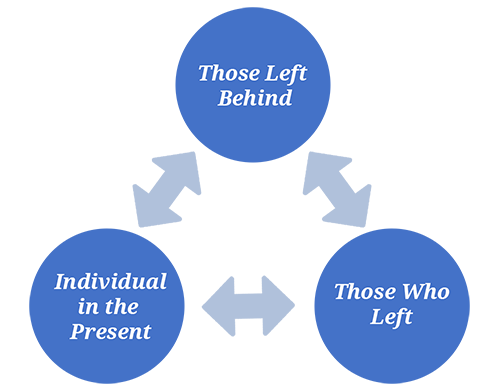
In each and every constellation that I have observed, the most animated and influential space was ‘those left behind’. An historical narrative of migration within the individual and family context cannot be ignored in either the individual or the collective dynamic. It is this triangulation that is the root cause of entanglements around a lack of compassionate response or a sacrificing response on a personal level in intimate and family relationships or to the current geo-political changes. And in turn the flow from the collective down through political structures, to communities, to families, then to the individual triggers a perceived threat to the belonging of the individual.
The past lives inside of us. Just for a moment, think about who you are and where you come from. Do you know where your grandparents are from, your great-grandparents, and the generations before them? Has there been movement within your family from one place to another? Were your ancestors ever forced to move? Did they lose their land or their livelihood? Can you imagine how difficult the move or moves were? It is impossible to uproot an entire family lineage and drop them into a new land without someone or something being left behind. Even if that is simply regret. Most commonly what is left behind is more than regret. It is the elder generations who cannot make the move. It is the early blossoming love that is left behind. It is the separation of parents and children. And it is this that creates the fractures within the field of belonging. It is the cost of this wound that rips apart the fabric of the family field that is carried forward.
Sound of Silence
The father and the father’s line are particularly important. They are influential on our physical and material belonging, on our sense of safety; on our ability to have and accept a place of belonging upon the land, and to be seen and heard within that context. This is no small thing. The culture and heritage of our ancestral land, encompassing religious, political and cultural beliefs, are ingrained in the unconsciously inherited memories of each of us as individuals. Each of us unknowingly carries the beliefs of those who have gone before us in our fields of influence. Often, those beliefs can be in stark contrast to our personal beliefs, causing us to hit potholes as we move forwards and actively attempt to be true to ourselves. The attempt can be anything from choosing a love outside of the belief system of our ancestors, to getting divorced, to choosing to work in a field dominated by the opposite gender or maybe choosing to follow a spiritual rather than religious path. Take a moment to think about times in your own life when you have chosen or attempted to choose yourself and follow your dreams? How smooth was your path forward? Do any bumps in the road come to mind? Can you choose to follow your own dreams without invoking old patterns of sacrifice and debt?
My understanding of the influence of the paternal line and field has deepened considerably over the last two decades. A pervasive feature of the paternal line and field that I have noticed is the presence of silence. The silence is often accompanied by guilt and overwhelmingly traumatic entanglements to previous generations. The types of traumas range from the suffering of war, violence or displacement and migration to the perceived weight of broken promises within the field, whether those promises were emotional, intimate or financial. The hidden entanglements appear time and again within the silence of this part of the constellation field. I began to understand the seeming absence of the men within the constellation process, because it is in fact very hard to look at and sit with such pain. The weight of the broken promises, particularly those relating to love and intimacy also open the door to a flood of messy, emotionally rooted entanglements that draw the focus away from the deeper roots of fractured and displaced belonging. But there is a great cost to consciously or unconsciously choosing not to see the fractures within the field of the paternal and it affects us all, individually and collectively.
The experience of this in present time for us as individuals, and the close generations around us, is of a significant number of silent, missing and absent men within our life. This symptom of the deep-rooted entanglements within the paternal line and field can actually serve to exacerbate the entanglements experienced within the dominating maternal line and field, which has a weighty influence on our emotional lives.
What this essentially means is that if we have a silently fractured relationship with our father and that line, then we can find ourselves drawn into emotional relationships that are similarly fractured. We can feel ourselves displaced or excluded within our relationships and friendships, not being or feeling seen by our partner. That horrible feeling of not being enough, not being seen and not being heard or valued, has its roots here within these entanglements. And this is a hard place to be – spinning our wheels in the quicksand of unhealthy relationships, trying to fix the emotional root, when the actual root issue is in an entirely different place.
But it doesn’t have to be that way.
For so many in the Western world there is massive geo-political change and an overt stirring of our collective historical narratives. There is a clash of deeply held beliefs that can seem at times intractable. This is the legacy of the inherited trauma. Our experience of it is both individual and collective. We are unconsciously seeing and being seen through this historical lens and this is why Family Constellations are so vital in this moment.
Our individual and collective history is inside us. The historical narrative of the land we come from: the country we inhabit and the world in which we live, is constantly flowing through us. This narrative is the lens through which we see those around us and through which we are seen.
For me constellations and the disentangling of the root traumas can bring a spark of hope to situations that can feel desperate and overwhelming. By looking at who we are and where we come from on an individual level, we are contributing, in no small way, to a greater collective shift.
And an understanding of the significance and influence of the paternal line and field is key to that.
Are you willing to step into your place as a free soul and ‘see’ the unseen and forgotten souls within your paternal line and Field?
REFERENCES
Boring, F. M. (2012) Connecting to Our Ancestral Past. North Atlantic Books, Berkeley, CA, USA.
Fierke, K., & Mackay, N. (2020) To ‘see’ is to break an entanglement: Quantum Measurement, Trauma and Security. Security Dialogue Journal. Ottawa, Canada.
(Digital reference for Security Dialogue: https://us.sagepub.com/en-us/nam/security-dialogue/journal200769#editorial-board
Mackay, N. (2009) The Science of Family: Working with Ancestral Patterns. O Books, Alresford, Hants, UK.
Mackay, N. (2012) Between the Lines: Healing the Individual & Ancestral Soul with Family Constellation. O. Books, Alresford, Hants, UK.
Schwartz, S. (2010) Nonlocality, Intention, and Observer Effects in Healing Studies: Laying a Foundation for the Future. Explore: The Journal of Science & Healing, September/October, 2010, Vol. 6, no.5, New York, NY, USA.
Schwartz, S. (2017) The Manipulation of Perceived Reality through Nonlocal Intention. Explore: The Journal of Science & Healing, NY, USA.
Shivanath, S. H. (2003) The psycho-dynamics of race and culture. In H. S. Hargaden, Ego states (Key concepts in transactional analysis: Contemporary views) (pp. 169–185). Worth Publishing, London, UK.